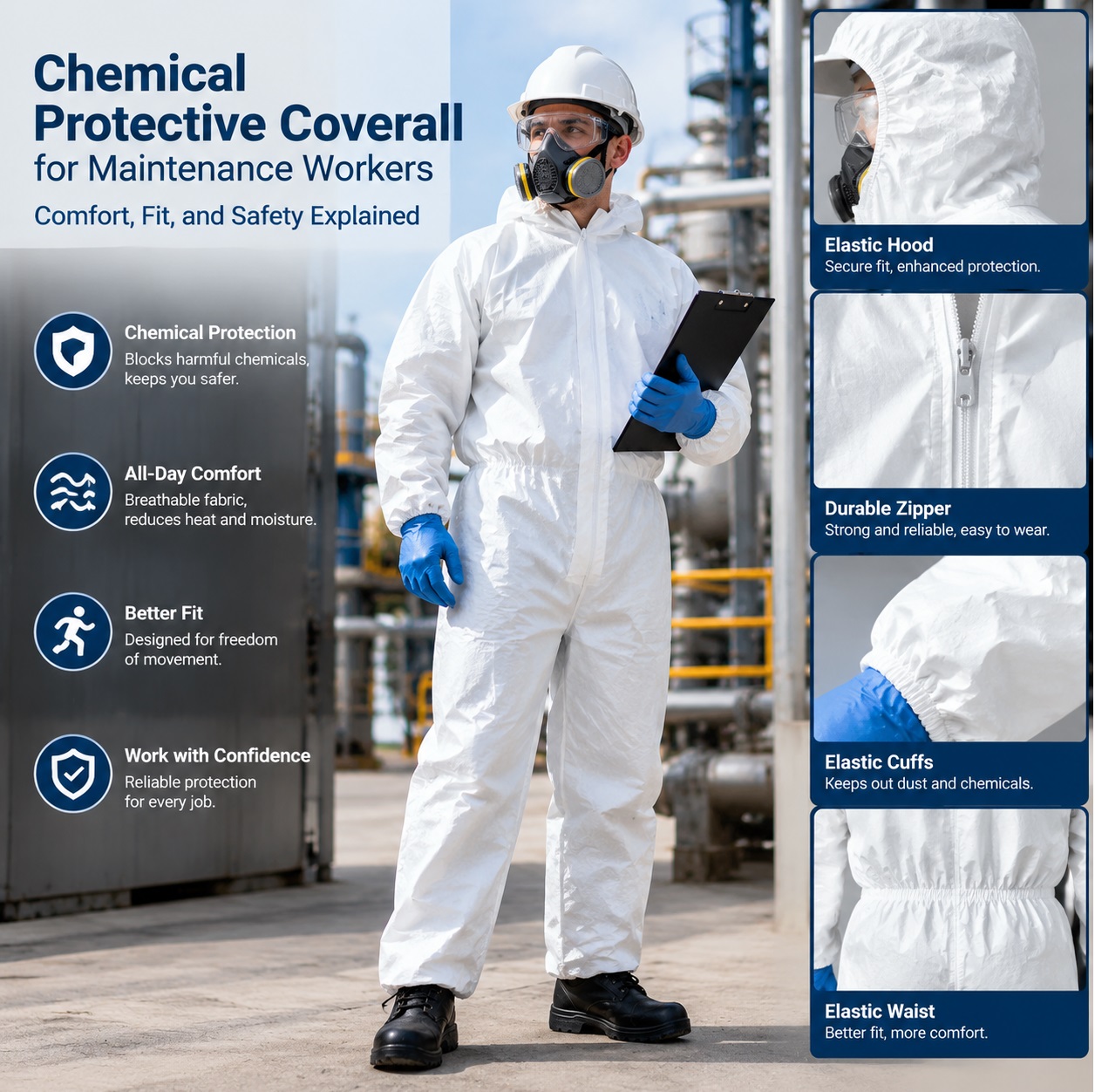
 A maintenance worker doesn’t need a coverall that looks tough on a spec sheet. He needs one that survives the third hour of a hot pump repair without turning into a sauna, lets him kneel behind a valve without splitting the crotch, and still blocks the splash he didn’t see coming.
That’s the real job of a chemical protective coverall. Not just to pass a lab test. To be worn. To be trusted. To be kept on when the shift gets ugly.
Comfort: The feature that keeps safety on the body
A coverall that traps heat is a coverall that gets unzipped. It’s simple human behavior. If workers are sweating through their shirts by 10 a.m., they’ll pull the hood down, open the front, or leave the suit in the locker next time. Comfort isn’t soft marketing language. It’s a compliance tool.
Look for fabrics that balance chemical resistance with breathability. Microporous films and SMS laminates can block liquid splashes while letting some moisture vapor escape. That matters during maintenance tasks: changing filters, repairing lines, cleaning tanks, handling drums. The work is stop-start, often in tight spaces, often with heat around the corner.
Also pay attention to the inside. A smooth, low-lint inner surface reduces irritation. A full-length zipper with a protective flap keeps the closure from digging in. Elasticated cuffs and ankles seal without cutting off circulation. If a coverall feels like a plastic bag, it won’t stay in service.
Fit: Where protection meets movement
One size fits all is a lie that shows up in the shoulders. Too baggy and the fabric snags on valves, ladder rungs, and machine edges. Too tight and it restricts reaching, crouching, and climbing. Either way, the worker is distracted. Distraction is how gloves get contaminated and hoods get adjusted with dirty hands.
A good chemical protective coverall is cut for real maintenance work. Look for gusseted crotches, raglan or set-in sleeves that allow overhead reach, and articulated knees for kneeling. A two-way zipper helps with quick bathroom breaks and ventilation during doffing. Thumb loops keep sleeves from riding up when arms are stretched. An elasticated waist keeps the suit from ballooning without squeezing.
Sizing should be based on height and chest measurement, not just S, M, L, XL. A worker who is 6’2″ and lean needs a different fit than someone 5’8″ and broad. If the coverall rides up in the crotch or pulls across the back, it’s the wrong size even if the label says otherwise. Comfort and fit are not vanity issues. They determine whether the barrier stays intact.
Safety: The non-negotiables
Safety starts with the chemical. Not every coverall handles every substance. A suit that shrugs off paint thinner may be useless against concentrated acid. Check permeation data, not just splash resistance. Look at breakthrough time. If the chemical is hazardous, a few minutes of protection may not be enough for the task.
Seams are often the weak point. Stitched seams can wick liquid. Taped or heat-sealed seams create a continuous barrier. The zipper needs a storm flap. The hood should fit over a hard hat or respirator without leaving gaps. Boot flaps should cover the top of the boot, not flap open. Elasticated wrists and ankles should sit snug against gloves and boots.
For maintenance workers, antistatic properties can also matter. Fuel, solvents, and dust in confined spaces make static discharge a real concern. A coverall with antistatic treatment helps reduce that risk, but it must be worn and grounded correctly as part of the full PPE system.
Then there’s the take-off. A contaminated coverall is dangerous during doffing. A front zipper that opens easily, a design that lets the worker peel the suit away from the body, and clear instructions for disposal or decontamination all reduce exposure. Safety doesn’t end when the task ends.
What maintenance teams should demand
Procurement often buys on price per unit. That’s understandable. But the real cost is measured in reorders, complaints, and near misses. A cheap coverall that tears at the shoulder or turns a worker into a sweaty mess will cost more in the long run.
Ask for samples in multiple sizes. Let workers kneel, reach, squat, and climb a ladder. Check the fabric against the chemicals actually used on site. Verify certifications for the required protection level. Then compare how the suit feels after twenty minutes, not twenty seconds.
A chemical protective coverall is not just a disposable garment. It’s a piece of safety equipment that has to work with the human body. Comfort keeps it on. Fit keeps it sealed. Safety keeps everyone going home.
When those three line up, maintenance workers stop fighting their PPE and start trusting it. That’s the coverall worth buying.